In modern construction, emergency rescue, municipal maintenance, and infrastructure renovation projects, precision concrete cutting is no longer simply about power. Today’s professionals demand deeper cutting capacity, lower vibration, safer operation, and greater adaptability to confined workspaces.
As 2026 construction trends increasingly focus on urban retrofit projects, underground utility upgrades, and emergency structural access, the choice between a hydraulic ring saw and a hydraulic circular cut-off saw has become a critical decision for contractors and project managers.
Recent industry trends emphasize smarter hydraulic systems, better cooling control, improved dust suppression, and deeper cutting performance for structural applications.
At ZONDAR, we often receive one common question:
“When should I choose a ring saw, and when is a cut-off saw the better option?”
This article provides a practical guide based on real-world applications.
Why This Choice Matters More in 2026
Concrete cutting requirements are changing.
Across municipal infrastructure projects and emergency response operations, contractors increasingly face:
Tight operational spaces
Reinforced concrete structures
Limited equipment access
Strict dust and vibration control requirements
Faster deployment expectations
Traditional cutting methods often struggle to meet these demands efficiently.
Modern hydraulic cutting systems are gaining wider adoption because they deliver consistent power output, superior cooling performance, and stable operation under continuous heavy load. Handheld hydraulic ring saws in particular are recognized for achieving significantly deeper cuts without requiring oversized blades.
Hydraulic Ring Saw: Built for Deep Structural Access
A hydraulic ring saw is specifically designed for maximum cutting depth within a compact handheld format.
Unlike conventional hydraulic cut-off saws, the ring blade design eliminates the center arbor limitation, allowing deeper penetration with the same blade diameter.
Best applications:
Door and window opening creation
Thick reinforced concrete wall cutting
Emergency rescue access points
Underground utility trench access
Structural modification projects
Key advantages:
1. Exceptional Cutting Depth
A ring saw can achieve cutting depths that would normally require a much larger conventional saw. This makes it ideal for projects where access is restricted.
2. Superior Performance in Confined Spaces
Compact body design allows easier handling in narrow corridors, basement structures, tunnels, and rescue environments.
3. Improved Operator Safety
Hydraulic drive systems offer smoother torque delivery with reduced kickback risk compared to high-speed gasoline systems.
4. Continuous Duty Capability
Hydraulic cooling maintains stable performance during extended operation.
This is why many professional rescue and municipal maintenance teams are increasingly adopting hydraulic ring saw systems.
For projects focused specifically on demolition efficiency and reinforced concrete access, understanding the deeper technical advantages of ring saw technology becomes essential. Many engineers prioritize hydraulic ring saw performance benefits when evaluating reinforced concrete cutting tools.
Hydraulic Circular Cut-off Saw: The Productivity Workhorse
A hydraulic cut-off saw remains the most efficient solution for fast, straight-line cutting and general-purpose concrete processing.
It is often the preferred choice when speed and repetitive cutting efficiency are priorities.
Best applications:
- Road maintenance cutting
- Asphalt slot cutting
- Pipe trench preparation
- Pavement repair
- Expansion joint cutting
Key advantages:
1. Faster Linear Cutting
Circular saws excel at long continuous cuts.
2. Lower Blade Replacement Cost
Disc blades are widely available and economical.
3. Simple Maintenance
Straightforward blade installation and servicing.
4. Excellent for Routine Municipal Work
Ideal for repeated daily infrastructure maintenance tasks.
The Real Decision: Depth vs Speed
When selecting between the two, the decision usually comes down to operational priorities.
Choose a Hydraulic Ring Saw if you need:
✓ Maximum cutting depth
✓ Structural opening precision
✓ Tight-space maneuverability
✓ Rescue-grade flexibility
Choose a Hydraulic Cut-off Saw if you need:
✓ High cutting speed
✓ Long straight cuts
✓ Routine roadwork efficiency
✓ Cost-effective repetitive operation
Why Hydraulic Systems Are Leading the Next Generation of Concrete Cutting
The industry is clearly moving toward cleaner, quieter, and more controlled cutting technologies, including hydraulic-powered systems with advanced cooling and water-management capabilities.
Compared with gasoline-powered alternatives, hydraulic systems offer:
- Zero onsite exhaust emissions
- Lower operational noise
- Reduced vibration fatigue
- Better compatibility with wet-cut dust suppression
- Modular connection with multiple hydraulic tools
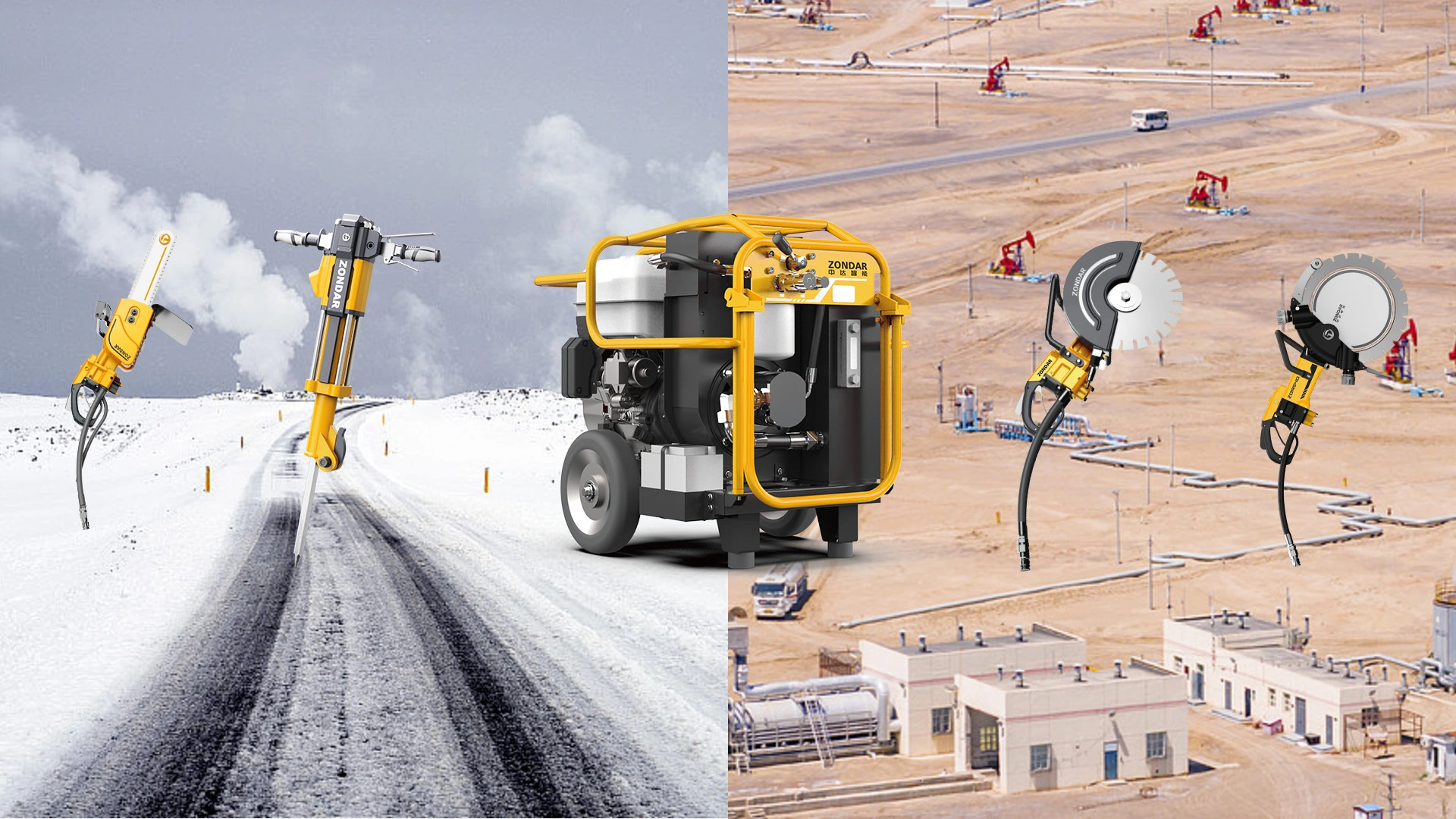
For contractors managing multi-tool field operations, a single hydraulic power unit can drive:
This modular efficiency significantly reduces equipment redundancy.
Of course, cutting performance depends not only on design concept, but also on manufacturing precision and system reliability. This is why professional contractors increasingly evaluate how equipment is engineered behind the scenes. ZONDAR’s commitment to precision manufacturing for hydraulic systems ensures long-term field reliability.
The ZONDAR Approach: One Power Source, Multiple Cutting Solutions
At ZONDAR, we design hydraulic cutting systems for real-world field demands.
Our hydraulic ring saws and circular saws are engineered for:
- High-strength reinforced concrete cutting
- Municipal emergency response
- Infrastructure maintenance
- Rescue access operations
- Continuous-duty industrial environments
Combined with ZONDAR hydraulic power units, operators gain a compact, modular, and rapidly deployable cutting solution that adapts to changing jobsite requirements.
Because in modern concrete cutting, the best tool is not simply the most powerful.
It is the one that delivers the right depth, right speed, and right control for the mission.
Final Thought
As project requirements become more demanding in 2026, choosing between a ring saw and a circular saw is no longer a basic equipment selection.
It is a strategic decision about efficiency, safety, deployment speed, and operational flexibility.
The future belongs to contractors who choose cutting systems built not only for today’s projects — but for tomorrow’s challenges.