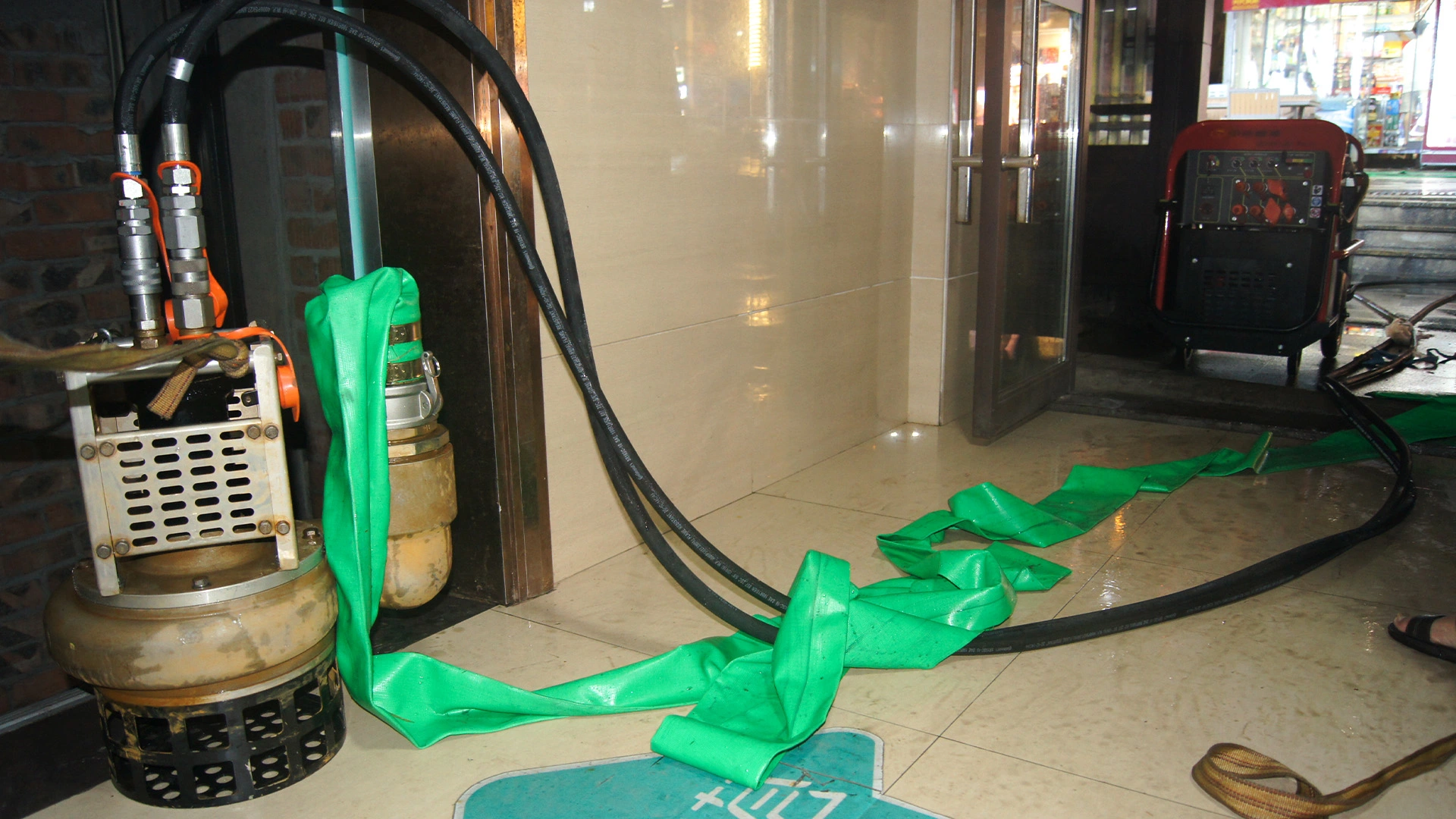
For construction contractors, choosing a portable hydraulic breaker is not simply a matter of selecting the largest or most powerful model available. The right equipment depends on the material being broken, the working environment, the required breaking method, and the amount of work expected on the jobsite.
A handheld hydraulic breaker can be used for a wide range of applications, including concrete demolition, road maintenance, utility trenching, frozen ground breaking, masonry removal, rock breaking, and emergency rescue work. However, the breaker itself is only one part of the system. The type of working tool or chisel installed on the breaker also has a direct influence on how the impact energy is transferred into the material.
For contractors evaluating a complete hydraulic tool system, the selection process should therefore consider three elements together: the application, the breaker and chisel combination, and the portable hydraulic power packs used to supply hydraulic flow and pressure.
Start With the Application, Not the Chisel
The most practical way to select a hydraulic breaker system is to start with the job rather than the equipment.
A contractor should first identify what needs to be broken or removed. Is the project mainly concrete demolition? Road and asphalt maintenance? Hard rock breaking? Utility trenching? Frozen ground? Emergency rescue? Or a mixture of several applications?
The answer determines what type of impact tool is most appropriate.
For example, a contractor working primarily on road maintenance may need an asphalt-specific working tool and a breaker capable of continuous operation. A demolition contractor dealing with reinforced concrete may place greater emphasis on penetration and controlled fracture. A utility contractor may need a relatively compact breaker that can work around trenches, pipes, kerbs, and other infrastructure.
This application-first approach helps prevent a common purchasing mistake: selecting a breaker based only on impact force or engine horsepower without considering how the tool will actually be used.
Moil Point: General Breaking and Penetration
The moil point, also called a pointed or conical tool, is one of the most versatile working tools for a hydraulic breaker.
Its pointed tip concentrates impact energy into a relatively small contact area. This makes it effective when the operator needs to penetrate a hard material and initiate cracks from a concentrated point.
For contractors, a moil point is generally worth considering for applications such as hard concrete, masonry, rock, boulders, frozen ground, and general demolition work.
It can be particularly useful when breaking starts from an intact surface and the operator needs to create an initial penetration point. In rock or thick concrete, the concentrated impact helps initiate fractures that can then be expanded as the work progresses.
For contractors who require one handheld hydraulic breaker for a variety of general-purpose breaking applications, a moil point is often a practical starting configuration.
However, a pointed tool is not automatically the best solution for every material. On some applications, a wider or wedge-shaped tool can provide better control or more efficient material separation.
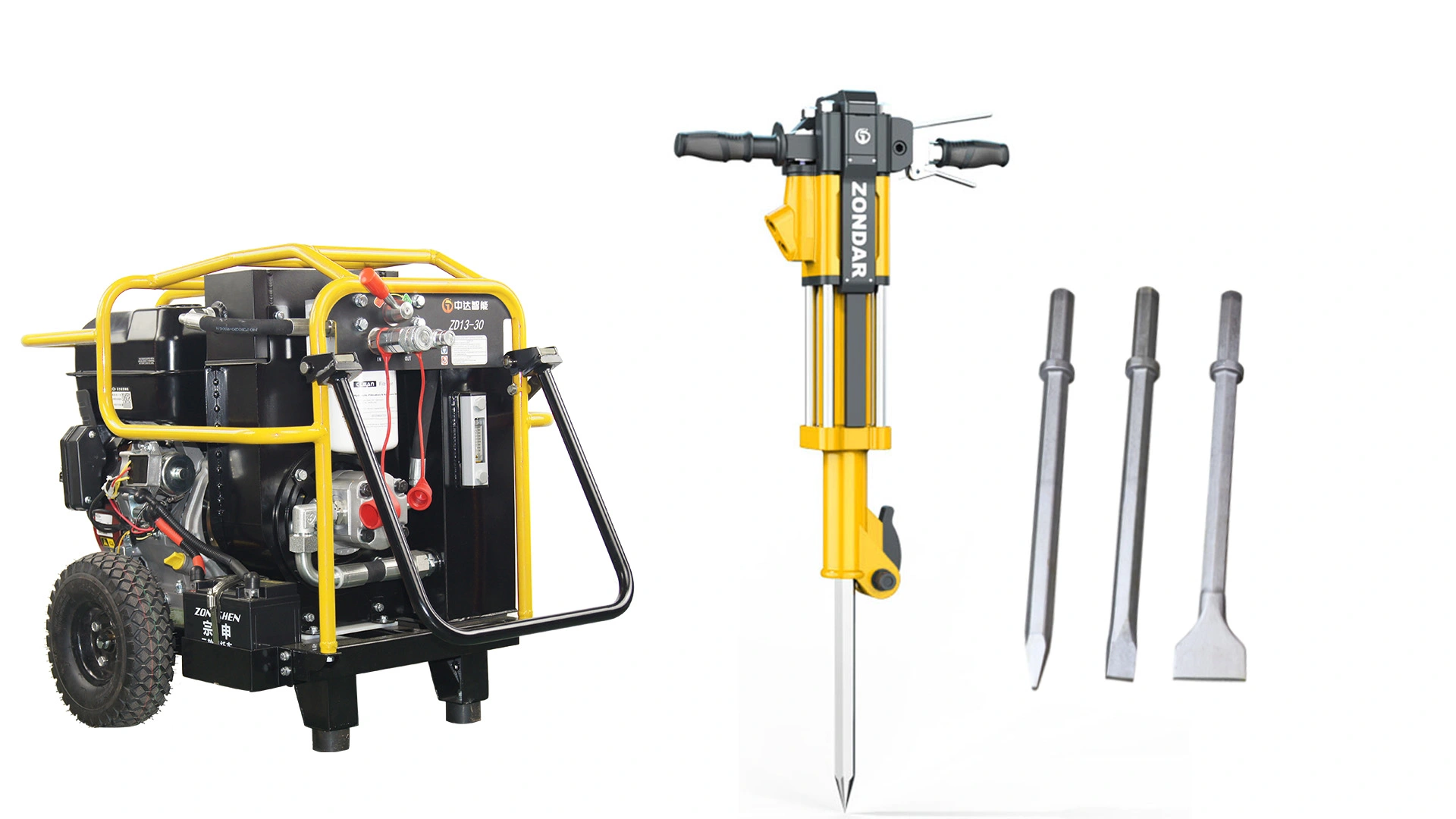
Narrow Chisel: Controlled Fracturing and Demolition
A narrow chisel has a blade-like working edge rather than a sharply pointed tip. Its geometry provides a more defined line of contact with the material.
This makes it suitable for controlled breaking and applications where the contractor wants to guide the direction of the fracture.
Typical applications include concrete demolition, breaking slabs, masonry removal, trimming concrete edges, and working along existing cracks or joints.
A narrow chisel can also be useful when removing sections of concrete around infrastructure where excessive damage outside the target area is undesirable.
For contractors involved in building renovation, utility maintenance, structural repair, or selective demolition, this type of working tool can provide more controlled material separation than a pointed tool.
Flat or Wide Chisel: Surface Removal and Slab Work
A flat chisel has a wider working edge and distributes impact across a larger area.
This configuration is useful when the objective is not simply to penetrate deeply but to break, separate, or remove a relatively broad section of material.
Typical applications include concrete slab removal, masonry work, surface preparation, tile or similar material removal, and certain pavement applications.
The wider working edge can help the operator work along a surface or fracture plane rather than repeatedly penetrating a single point.
For contractors handling relatively thin concrete sections or surface-removal projects, a flat chisel may therefore be more suitable than a moil point.
Asphalt Cutter: Road Construction and Pavement Maintenance
Road contractors have a different requirement because asphalt behaves differently from concrete and rock.
An asphalt cutter or wide asphalt chisel is designed to create a more defined cutting or separation action through pavement. It can be particularly useful for road repair, utility trenching, pavement maintenance, and removing asphalt around access points.
For example, when a utility contractor needs to open a section of road to access underground pipes or cables, a specialized asphalt working tool can help create a controlled working area before excavation.
This is an important distinction when selecting a portable hydraulic breaker hammer. A contractor whose primary workload is asphalt maintenance should evaluate the breaker and working tool as a road-maintenance system rather than simply choosing a general demolition configuration.
Blunt Tool: Secondary Breaking and Large Material
A blunt or flat-ended tool distributes impact over a larger contact area than a pointed tool.
It can be useful when the objective is crushing or secondary breaking rather than deep penetration. Typical applications may include secondary breaking of oversized rocks, already-fractured concrete, large concrete blocks, and certain material-processing operations.
This distinction is particularly important in quarrying and aggregate-related applications. When large pieces have already been fractured and need to be reduced further, concentrated penetration is not always the most efficient approach.
A blunt tool can provide a broader impact area and support the crushing or fragmentation process.
Wedge Chisel: Splitting and Defined Fracture Lines
A wedge-shaped chisel creates a more directional splitting effect.
This type of working tool can be useful when contractors need to break material along a relatively controlled line rather than simply create random fractures.
Potential applications include concrete slab removal, splitting certain types of stone, working along joints, and controlled demolition.
The key advantage is not maximum penetration but the ability to use the geometry of the tool to influence how the material separates.
For contractors performing selective demolition or infrastructure repair, this distinction can be important because the objective is often to remove a specific section while leaving adjacent structures intact.
Quick Reference: Chisel Selection Guide for Hydraulic Breakers
| Chisel Type | Working Geometry | Best Applications | Key Advantage |
| Moil Point | Conical / Pointed tip | Hard concrete, rock breaking, boulders, frozen ground, general demolition | Concentrates energy into a small area for maximum penetration and initial cracking. |
| Narrow Chisel | Narrow blade-like edge | Concrete demolition, slab breaking, masonry removal, structural trimming | Provides controlled fracture lines and guided material separation. |
| Flat / Wide Chisel | Broad flat edge | Concrete slab removal, surface preparation, tile removal, thin pavement work | Distributes impact across a wider area for efficient surface-level removal. |
| Asphalt Cutter | Wide, sharp cutter blade | Road maintenance, asphalt cutting, utility trenching, pavement edge trimming | Creates clean, defined cuts through asphalt without damaging surrounding pavement. |
| Blunt Tool | Flat, unsharpened end | Secondary rock breaking, crushing large fractured concrete, quarrying | Distributes heavy impact energy over a large contact area for crushing rather than penetration. |
| Wedge Chisel | Wedge-shaped edge | Concrete splitting, stone splitting, working along expansion joints | Delivers a directional splitting force to isolate and remove specific structural sections. |
Frozen Ground and Difficult Ground Conditions
Breaking frozen ground presents another specialized application.
When soil becomes heavily compacted or frozen, conventional excavation equipment may struggle to penetrate the surface. A hydraulic breaker with a suitable pointed or wedge-style working tool can provide the concentrated impact required to initiate fractures and loosen the ground.
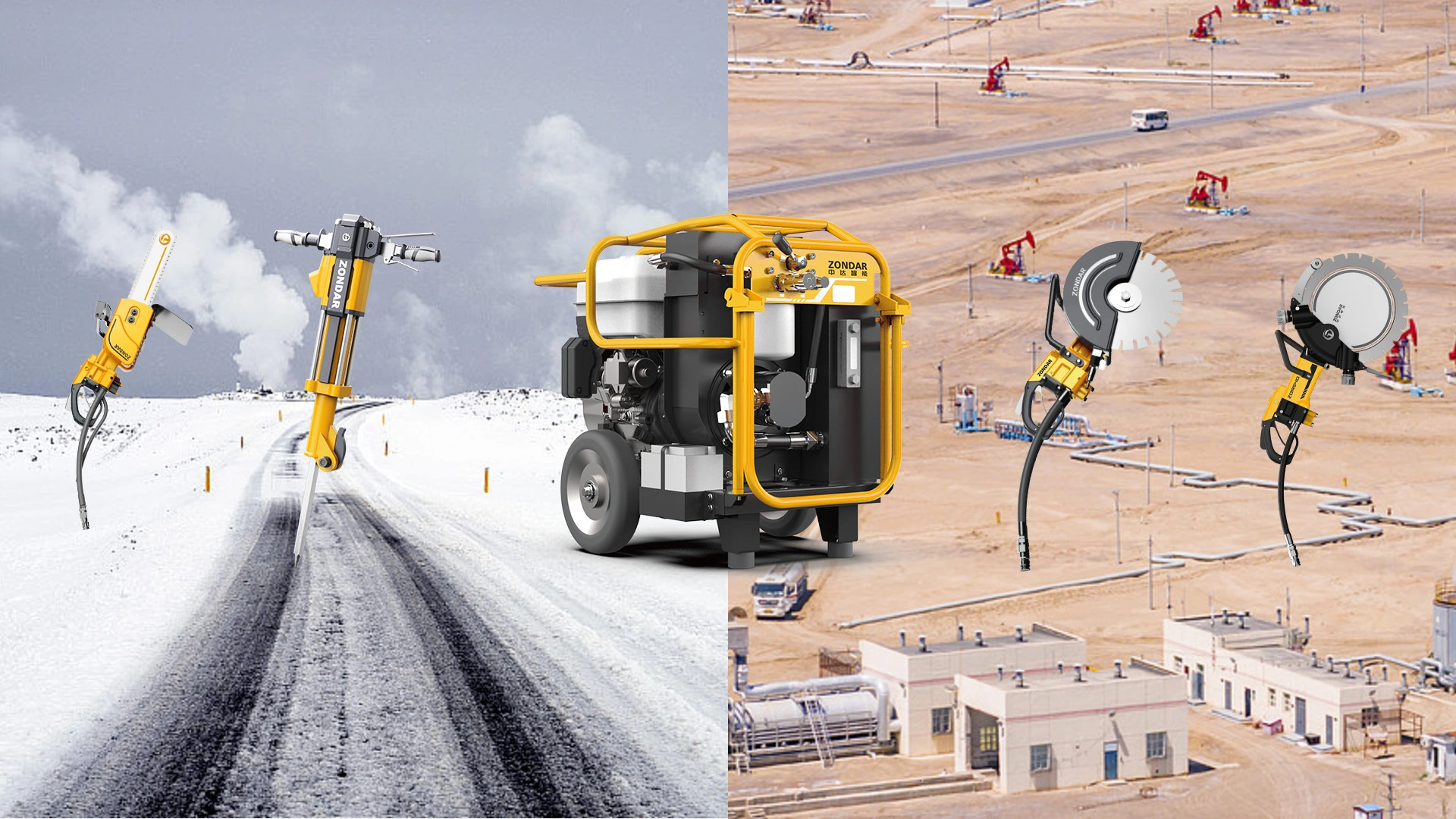
This can be relevant to utility contractors, pipeline projects, road construction, municipal maintenance, and emergency repair work in cold climates.
In these conditions, the contractor should consider not only the chisel profile but also breaker weight, impact energy, operating frequency, and the ability of the hydraulic power source to maintain stable performance during continuous operation.
Reinforced Concrete Requires a Different Approach
Reinforced concrete presents a more complicated challenge because the breaker must deal with both concrete and steel reinforcement.
A pointed or narrow working tool can help fracture the concrete around reinforcement, while the operator may need to change the working position or tool depending on the structure and demolition sequence.
For heavy reinforced concrete, foundations, bridge components, and thick structural members, contractors should not assume that simply increasing breaker size will automatically improve productivity.
The breaker must be appropriate for the material thickness and working environment, while the working tool must allow the operator to efficiently initiate and extend fractures.
Large handheld hydraulic breakers are available for demanding applications such as heavy asphalt and reinforced concrete, demonstrating that breaker size and application should be considered together rather than independently.
Choosing the Right Breaker for the Job
Once the material and working method are understood, the contractor can select the appropriate breaker.
A lightweight handheld hydraulic breaker may be preferable for utility maintenance, light demolition, masonry work, and jobs where frequent manual repositioning is required.
A heavier handheld hydraulic breaker hammer may be more appropriate for thick concrete, heavy asphalt, foundations, and demanding demolition applications.
The key is to match breaker size to the workload rather than simply choosing the biggest available model.
A breaker that is too small may result in slow productivity and excessive operating time. A breaker that is unnecessarily large may increase operator fatigue, transportation requirements, and overall equipment cost.
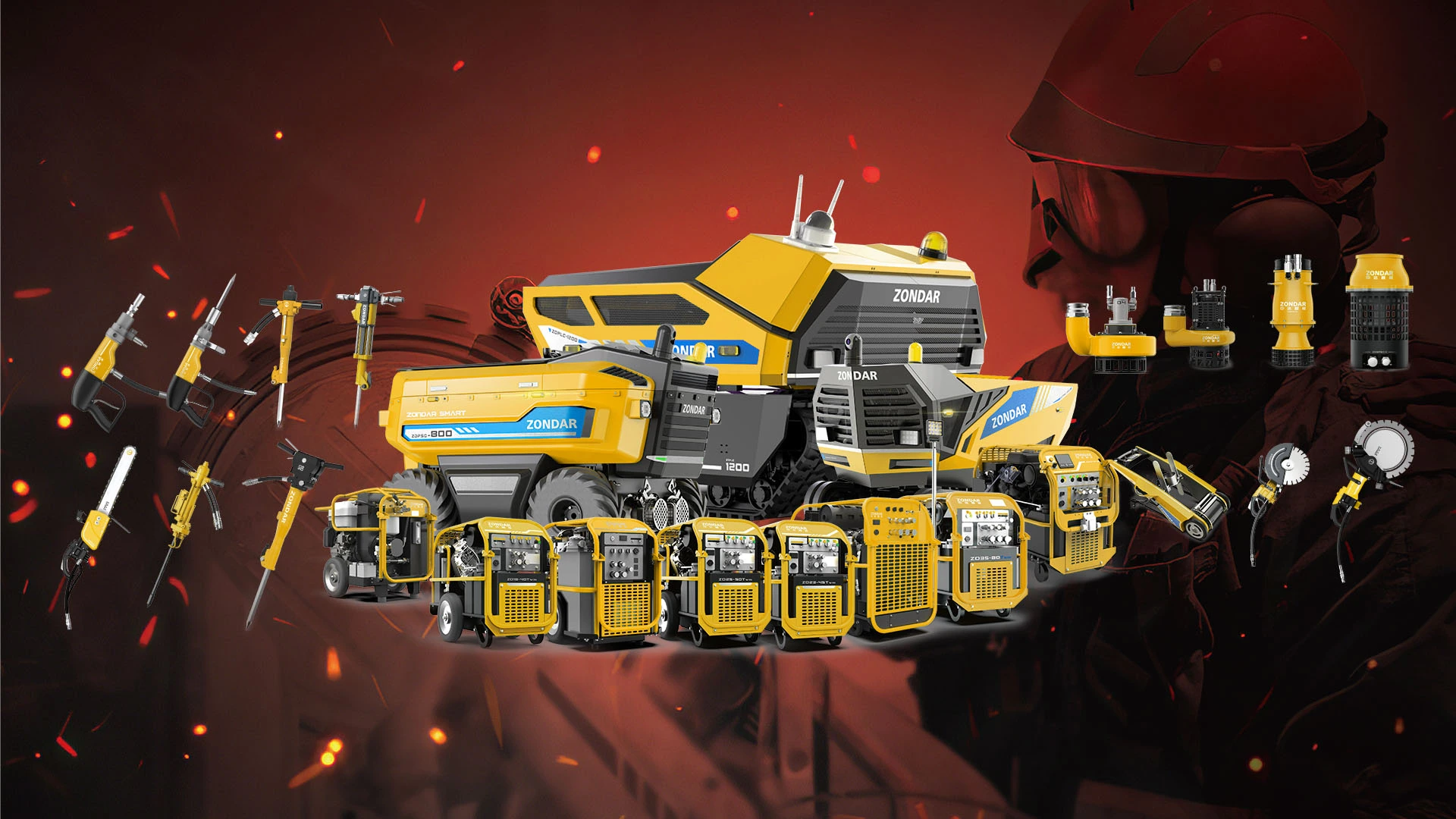
Selecting the Portable Hydraulic Power Pack
The hydraulic breaker must also be matched with an appropriate power source.
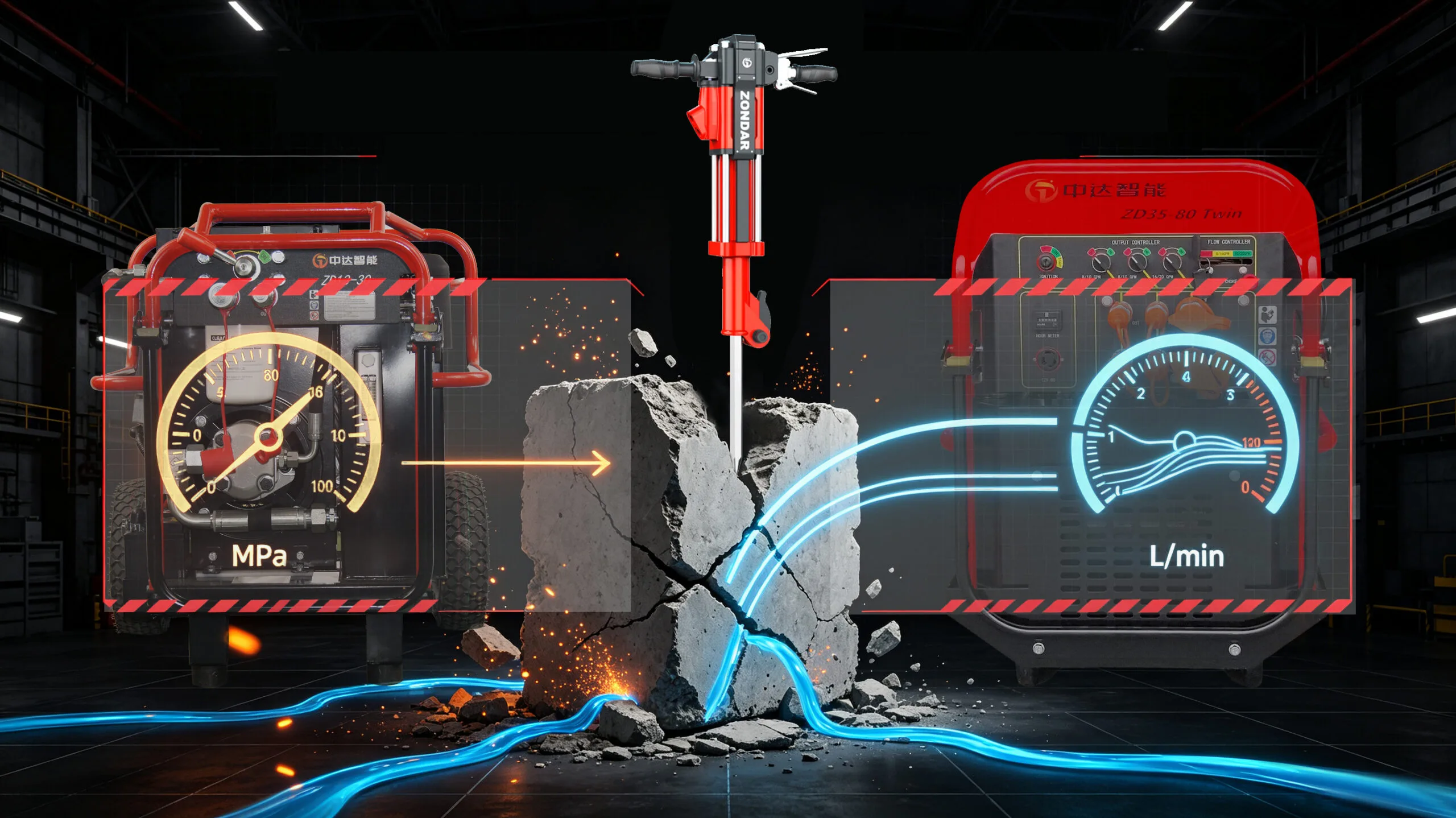
Portable hydraulic power packs convert engine power into hydraulic energy and provide the flow and pressure required by handheld hydraulic tools. The correct hydraulic flow and operating pressure are therefore essential for achieving the intended breaker performance.
For example, different handheld breakers can require different hydraulic flow ranges. Manufacturer specifications should always be checked before selecting the power pack, because insufficient flow can reduce performance while excessive flow may cause overheating or unnecessary stress on hydraulic components.
For contractors purchasing a complete system, the power pack should therefore be selected at the same time as the breaker.
The practical selection sequence is:
Application → Material → Breaking method → Chisel type → Breaker size → Hydraulic flow and pressure → Power pack.
This approach is more reliable than selecting a power pack first and trying to find a breaker afterward.
Matching Equipment to Different Contractor Applications
Different contractors may have very different equipment priorities.
For road construction and maintenance, an asphalt cutter or wide chisel combined with a suitable breaker can be useful for pavement work.
For building demolition, a moil point or narrow chisel may provide the penetration and controlled fracture required for concrete and masonry.
For utility contractors, a compact breaker with a versatile chisel can be useful for working around trenches, pipes, manholes, kerbs, and other infrastructure.
For municipal maintenance, equipment flexibility can be particularly important because the same crew may encounter concrete, asphalt, masonry, and compacted ground during different jobs.
For emergency rescue, portability and rapid deployment may be more important than maximum breaker size. A compact hydraulic power unit and handheld breaker can provide a practical solution where large construction machinery cannot reach the working area. Portable hydraulic systems are also used where compact equipment and flexible deployment are important in confined or difficult-access environments.
For quarrying and rock-related work, contractors should focus more heavily on penetration, rock characteristics, breaker impact energy, and the appropriate pointed or blunt working tool depending on whether the task is primary or secondary breaking.
Think of the Breaker as a Complete System
One of the most important considerations for contractors is that the breaker should not be evaluated as an isolated product.
A hydraulic breaking system consists of the power source, hydraulic circuit, hoses, couplers, breaker, and working tool. The performance of one component affects the others.
A high-performance breaker connected to an incorrectly sized power pack will not necessarily deliver better productivity. Likewise, a powerful breaker using a working tool that is poorly suited to the material may waste impact energy and increase tool wear.
This is why professional equipment selection should begin with the contractor’s actual workload.
The objective is not to find the most powerful breaker or the largest hydraulic power pack. The objective is to create a system in which the portable hydraulic power packs, handheld hydraulic breaker, and working tool are appropriately matched to the job.
A Practical Selection Strategy for Contractors
Before purchasing a hydraulic breaker system, contractors can evaluate several basic questions.
First, what materials will be broken most frequently?
Second, is the main objective penetration, controlled splitting, surface removal, pavement cutting, or secondary breaking?
Third, how thick or hard are the materials?
Fourth, how frequently will the breaker be used and for how many hours per day?
Fifth, does the job require a lightweight manually operated system or a heavier-duty breaker?
Finally, what hydraulic flow and pressure does the selected breaker require, and which portable hydraulic power pack can provide those parameters reliably?
Answering these questions creates a much clearer equipment specification and reduces the risk of selecting a system that is either underpowered or unnecessarily oversized.
Conclusion
For engineering contractors, choosing a hydraulic breaker should be an application-driven decision rather than simply a product comparison.
The type of chisel determines how impact energy interacts with the material. A moil point is suitable for penetration and general hard-material breaking, a narrow chisel provides more controlled fracture, a flat or wide chisel is useful for surface and slab work, an asphalt cutter is designed for pavement applications, while blunt and wedge tools can address specialized breaking and splitting requirements.
The next step is to match the working tool with the appropriate handheld hydraulic breaker or portable hydraulic breaker hammer, and then select portable hydraulic power packs that provide the required hydraulic flow and pressure.
For contractors, this approach creates a more practical equipment-selection framework:
Choose the application first. Match the chisel to the material. Match the breaker to the workload. Then match the power pack to the breaker.
When these elements are properly coordinated, a portable hydraulic system can provide a flexible solution across construction, demolition, road maintenance, utility work, municipal engineering, rock breaking, and emergency response.