When choosing a hydraulic pump for drainage, water transfer, or emergency dewatering, contractors often focus on one question: How much water can the pump move?
However, maximum flow rate is only one part of pump performance.
In real-world applications, water may need to be lifted from a deep underground space, transported through a long discharge hose, or moved through a system with significant elevation differences. In these situations, a pump with a very high flow rate may not necessarily deliver the expected performance.
This is where the difference between high-flow and high-head hydraulic pumps becomes important.
A high-flow pump is primarily designed to move a large volume of liquid within suitable operating conditions. A high-head pump is designed to maintain useful water movement when the pump must overcome greater vertical lift and system resistance.
Understanding this difference can help contractors, municipal teams, emergency responders, and equipment operators select a hydraulic pumping system based on the actual jobsite requirements rather than simply choosing the pump with the largest advertised flow rate.
What Does Hydraulic Pump Flow Rate Mean?
Flow rate describes how much liquid a pump can move over a specific period of time.
Pump flow is commonly expressed in:
- m³/h — cubic meters per hour
- L/min — liters per minute
- GPM — gallons per minute
For example, a pump rated at 200 m³/h has a greater theoretical water-moving capacity than a pump rated at 100 m³/h under comparable operating conditions.
For flood control and emergency drainage, high flow can be extremely valuable when a large volume of relatively accessible water needs to be removed quickly.
Typical applications include:
- Flooded roads
- Construction sites
- Open drainage areas
- Large surface water accumulation
- Municipal emergency drainage
- Water transfer between relatively low-resistance locations
However, the advertised maximum flow is not necessarily the flow the pump will deliver in every installation.
Actual performance can change according to discharge head, hose length, hose diameter, fluid characteristics, elevation difference, fittings, and other system resistance.
This is why pump selection should not be based on maximum flow alone.
What Does Pump Head Mean?
Pump head describes the pump’s ability to move liquid against elevation and resistance.
It is commonly expressed in meters of head.
In practical terms, head becomes increasingly important when water needs to be moved upward or pushed through a system where resistance is significant.
Consider two drainage projects.
In the first project, a pump removes water from a shallow construction site and discharges it a relatively short distance away. The elevation difference is small and the discharge path has relatively low resistance.
In the second project, water must be removed from an underground garage and discharged to a location significantly higher than the pump. The discharge hose may also be long, creating additional resistance.
The second project places greater demands on pump head.
This means that a pump with a very high flow rating may not be the most suitable option if it cannot maintain sufficient performance under the required head.
High-Flow vs. High-Head: The Basic Difference
The easiest way to understand the difference is to think about volume versus lifting capability.
| Parameter | High-Flow Hydraulic Pump | High-Head Hydraulic Pump |
| Main priority | Moving a large volume of liquid | Moving liquid against greater lift/resistance |
| Key performance concern | Flow rate | Discharge head |
| Typical applications | Large-volume drainage and water transfer | Deep drainage and long/elevated discharge |
| Typical jobsite | Open or relatively low-resistance areas | Underground, deep, or elevated discharge locations |
| Main selection question | How much water needs to be moved? | How far and how high must the water be moved? |
Neither type is automatically better.
The correct choice depends on the hydraulic and environmental conditions of the application.
Why High Flow Does Not Always Mean Better Drainage
One of the most common mistakes in pump selection is assuming that the pump with the largest flow rating will always drain an area faster.
Suppose a pump has a very high maximum flow under low-head conditions. If the actual installation requires significant vertical lifting or long-distance discharge, the pump may operate far away from its maximum-flow condition.
The result can be a much lower actual flow than expected.
This is similar to choosing a vehicle based only on its maximum speed without considering whether it can carry the required load or operate effectively on a steep road.
For hydraulic pumps, the operating point matters.
The pump must be evaluated according to the combination of:
Flow + Head + Discharge Conditions
rather than maximum flow alone.
This is particularly important in emergency drainage, where the difference between a shallow surface flood and a deep underground flood can completely change the equipment requirements.
Why High Head Does Not Always Mean Better Drainage
The opposite misunderstanding is also possible.
A high-head pump is not automatically the best choice for every drainage project.
If water needs to be moved across a large open area with little elevation difference, an extremely high-head configuration may not provide a meaningful advantage.
For example, a municipal team may need to remove a large volume of rainwater from a low-lying road after a storm. If the discharge point is nearby and the elevation difference is small, a high-flow pump may be more relevant than a pump selected primarily for high head.
In this situation, the key question is not:
“How much head can the pump produce?”
It is:
“How much water needs to be moved, and what resistance does the discharge system create?”
High-Head Applications: Where Do They Matter?
High-head capability becomes particularly important when water must be moved through challenging discharge conditions.
Typical applications include:
Underground Garages
Water naturally accumulates in low-lying underground structures.
Once water enters an underground garage, the pump may need to lift it upward to a surface-level discharge point. A pump selected only according to its maximum flow may not perform as expected if it cannot maintain sufficient discharge capability at the required elevation.
Tunnels and Underground Facilities
Tunnels can create long and difficult drainage paths.
The pumping system may need to overcome both elevation difference and friction losses in the discharge hose or pipeline.
In these conditions, pump head becomes an important part of the equipment specification.
Deep Construction Excavation
Construction sites may require temporary dewatering from excavations located significantly below the discharge point.
The deeper the excavation and the more demanding the discharge route, the more important it becomes to evaluate pump head together with flow.
Long-Distance Water Discharge
Even when the elevation difference is relatively moderate, a long discharge hose can create additional resistance.
Hose diameter, length, fittings, bends, and other components all influence the actual operating conditions.
Therefore, a pump that appears suitable based on its maximum flow may require further evaluation before being used for long-distance discharge.
High-Flow Applications: Where Do They Matter?
High-flow pumps are particularly useful when the primary challenge is the volume of water rather than extreme lifting requirements.
Examples include:
- Urban flash-flood drainage
- Large construction sites
- Road and underpass drainage
- Reservoir or pond water transfer
- Surface floodwater removal
- Large-volume emergency dewatering
In these applications, moving more water per hour can reduce the time required to lower the water level.
However, the pump still needs sufficient head for the actual discharge route.
High flow and adequate head therefore need to be considered together.
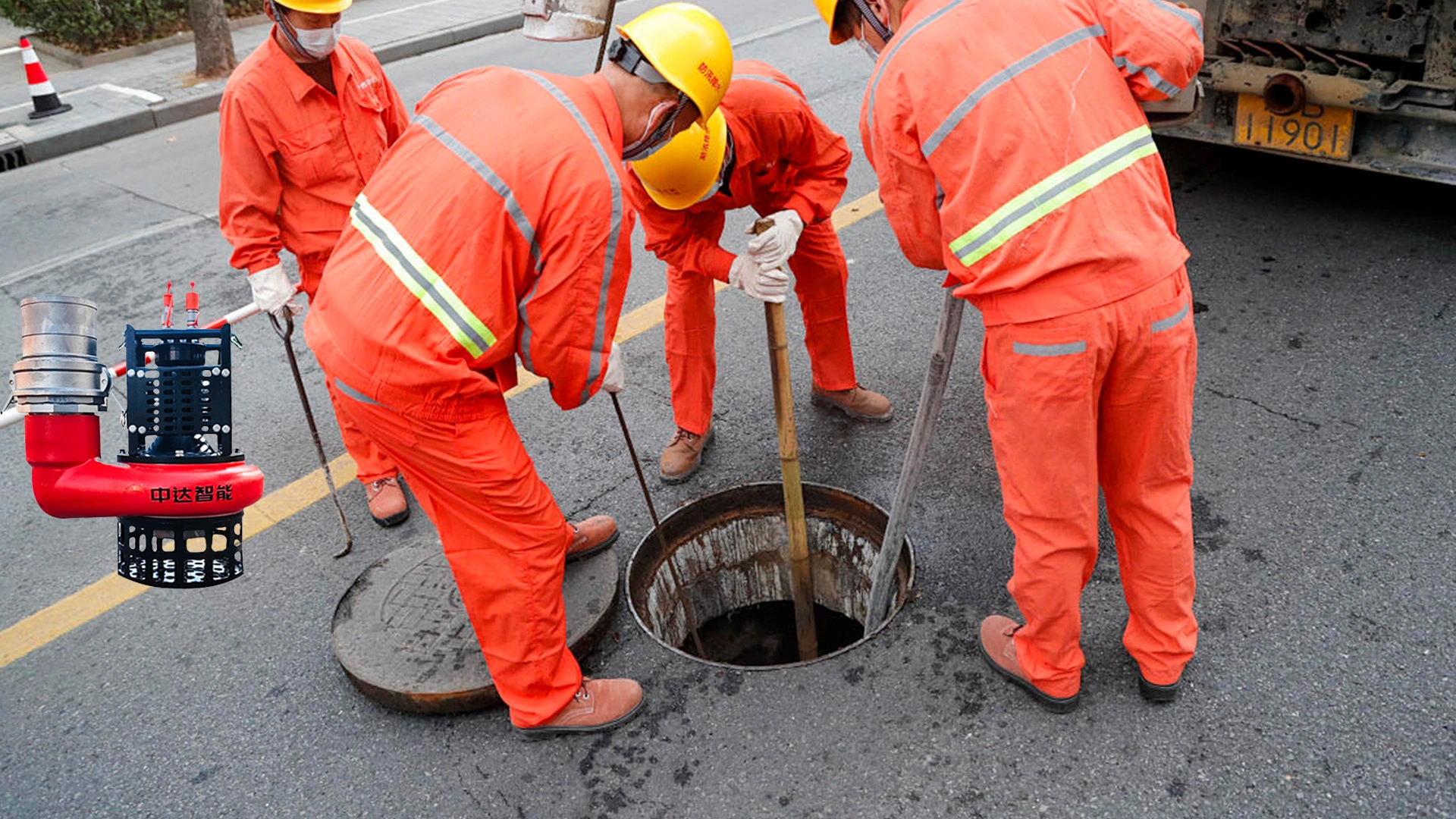
ZONDAR’s High-Head Hydraulic Submersible Pump
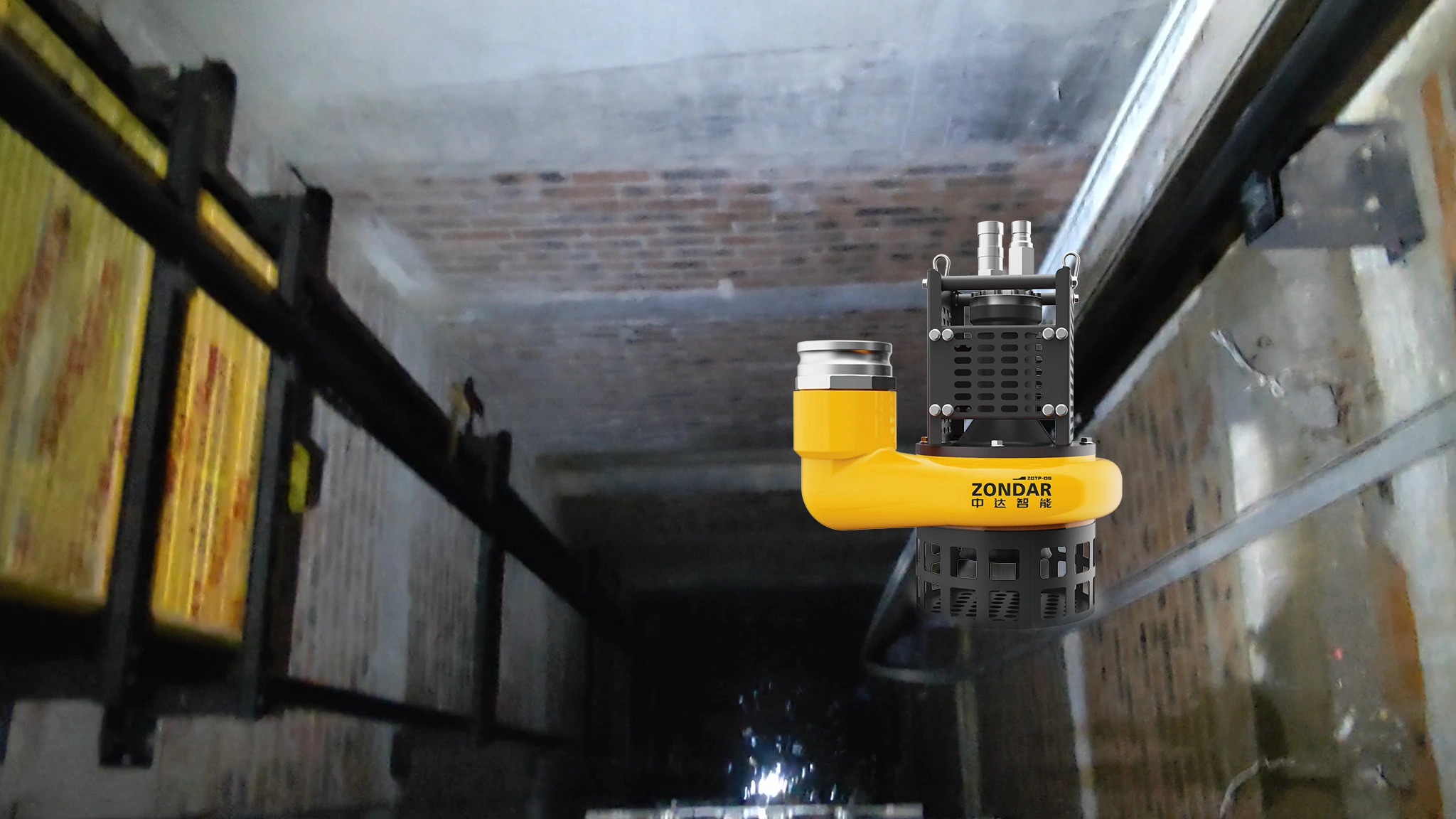
For applications that combine substantial water volume with demanding discharge conditions, ZONDAR offers the ZDTP04/06H high-head hydraulic submersible pump.
The ZDTP-06H uses a 6-inch discharge outlet and is designed for demanding water transfer and emergency dewatering applications. Its hydraulic input flow range is approximately 40–60 L/min, while the larger outlet configuration provides greater water-moving capacity than smaller pump models.
The value of this type of configuration becomes clearer when looking at the complete pumping system.
The hydraulic power unit remains outside the flooded area and supplies hydraulic power through hoses to the submerged pump. This separates the engine and hydraulic power source from the pumping location.
For emergency drainage, this configuration can be useful when electrical power is unavailable, unsuitable, or difficult to deploy near the flooded area.
The important point, however, is that a high-head pump should still be selected according to the actual flow, head, discharge distance, hose configuration, and site conditions.
High-Head and High-Flow Can Exist in the Same Pump
High-head and high-flow should not always be treated as two completely separate categories.
Some pumps are designed to provide a combination of substantial flow and useful head.
This is particularly valuable for emergency dewatering because real flood conditions are rarely simple.
For example, a flooded underground facility may require:
- A large volume of water to be removed.
- Water to be lifted vertically.
- Water to travel through a long discharge hose.
- Reliable operation in a wet and debris-containing environment.
A pump selected only for high flow may struggle with the required discharge conditions.
A pump selected only for maximum head may not provide enough water-moving capacity.
The objective is therefore to find an appropriate operating point for the complete system.
How Pump Head and Flow Work Together
The relationship between flow and head is similar to the relationship between speed and resistance in many engineering systems.
As the required head increases, the actual flow available from a pump generally changes.
This is why pump manufacturers often provide performance curves rather than presenting only one maximum flow figure.
A pump curve can help engineers understand how the pump performs under different head conditions.
For example:
Low head → potentially higher flow
Higher head → generally lower flow
The exact relationship depends on the pump design.
Therefore, when evaluating a pump, it is better to ask:
“What flow can this pump deliver at my required head?”
rather than:
“What is the maximum flow of this pump?”
This is one of the most important principles in practical pump selection.
Do Not Confuse Hydraulic Input Flow With Pump Water Flow
Hydraulic equipment creates another important distinction.
A hydraulic pump may have a hydraulic input requirement expressed in L/min, while its water output is expressed in m³/h.
These are not the same measurement.
For example, a hydraulic submersible pump may require a certain amount of hydraulic oil flow from the hydraulic power unit to operate its hydraulic motor. The pump then converts that hydraulic energy into mechanical rotation and uses that rotation to move water.
Therefore, when matching a hydraulic submersible pump with a hydraulic power unit, two different flow parameters need to be considered:
Hydraulic input flow → supplied by the hydraulic power unit
Water flow → produced by the pump
Confusing these two values can lead to incorrect equipment selection.
This is also why understanding hydraulic flow and pressure is important when designing a complete hydraulic system.
How to Choose Between High-Head and High-Flow
A practical selection process can start with five questions.
1. How much water needs to be moved?
Estimate the required drainage volume and the desired drainage time.
If the water volume is extremely large, flow capacity becomes a major consideration.
2. How high does the water need to be lifted?
Measure the vertical elevation between the pumping location and the discharge point.
Greater elevation difference increases the importance of pump head.
3. How far does the water need to travel?
A long discharge route can introduce additional resistance.
Consider hose length, diameter, bends, fittings, and other components.
4. What type of water is being pumped?
Clean water, muddy water, slurry, and debris-containing floodwater can require different pump configurations.
For example, hydraulic slurry pumps are designed for applications where suspended solids and abrasive material are important considerations.
5. What hydraulic power source is available?
A hydraulic submersible pump depends on an external hydraulic power unit.
The HPU needs to provide the required hydraulic flow and pressure within the pump’s specified operating range.
For contractors selecting the complete system, the power source should therefore be considered together with the pump rather than separately.
[Anchor Text: hydraulic power unit selection → Target Article: “How to Select a Hydraulic Power Unit for Handheld Tools: A Flow, Pressure, and Power Pack Sizing Guide for Contractors and Utility Crews”]
A Simple Decision Framework
The following framework can help contractors make an initial assessment:
Large water volume + short discharge distance + low elevation
→ Prioritize appropriate flow capacity.
Moderate water volume + significant vertical lift
→ Pay closer attention to pump head.
Large water volume + significant vertical lift
→ Look for a pump that provides a practical balance of flow and head.
Muddy or debris-containing floodwater
→ Consider pump passage capability, wear resistance, and the suitability of a slurry or submersible pump.
Emergency response in remote or flooded environments
→ Consider the complete system, including pump, hydraulic power unit, hoses, couplers, transport requirements, and deployment time.
The final selection should always be based on the manufacturer’s performance data and the actual site conditions.
Why Hose Selection Also Matters
Pump performance does not depend on the pump alone.
The discharge hose is part of the hydraulic water-transfer system. A hose that is too small can create additional resistance, while excessive hose length can also affect the actual operating point.
For hydraulic equipment, the same principle applies to the hydraulic circuit itself: hose diameter, flow rate, pressure, couplers, and connection configuration should all be considered as part of the complete system.
This is particularly important for mobile emergency equipment, where operators may need to balance performance with portability and rapid deployment.
High-Head vs. High-Flow: The Key Takeaway
The difference between high-head and high-flow hydraulic pumps can be summarized simply:
High flow is primarily about moving more liquid.
High head is primarily about overcoming greater lifting and discharge resistance.
But real-world pump selection is rarely that simple.
A pump may need to handle a large volume of water while also overcoming vertical elevation, long discharge distances, hose resistance, and difficult site conditions.
Therefore, the right question is not:
“Which pump has the highest flow?”
or:
“Which pump has the highest head?”
Instead, ask:
“What flow can the pump deliver under the head and discharge conditions of my actual application?”
This approach provides a much more useful basis for selecting emergency dewatering equipment.
Conclusion
High-head and high-flow hydraulic pumps serve different priorities, but neither should be considered in isolation.
High-flow capability is valuable when large volumes of water need to be moved quickly. High-head capability becomes increasingly important when water must be lifted vertically or discharged through a system with significant resistance.
For contractors, municipal teams, construction companies, and emergency responders, effective pump selection should therefore consider:
Required water flow → Required head → Discharge distance → Hose and system resistance → Fluid characteristics → Hydraulic power requirements
ZONDAR’s range of hydraulic slurry pumps and hydraulic submersible pumps is designed for different drainage and water-transfer conditions. The key is not simply choosing the largest pump, but selecting a configuration that matches the actual operating conditions.
When flow, head, hydraulic input, hose configuration, and application requirements are considered together, a hydraulic pumping system can deliver more predictable and effective performance in emergency dewatering, construction drainage, municipal flood response, and other demanding field applications.