When breaking reinforced concrete, removing large rocks, or carrying out demolition in confined areas, choosing the right hydraulic tool can make a significant difference to the work process.
Two commonly used options are the hydraulic rock splitter and the handheld hydraulic breaker. Both are designed for breaking hard materials, but they work in very different ways. A hydraulic breaker uses repeated impact force, while a hydraulic rock splitter generates high-pressure expansion force to split material along a controlled direction.
So, which tool is better for your project?
The answer depends on the material, demolition method, site conditions, and the level of control required. It is also important to consider their different hydraulic power requirements, especially when both tools are needed on the same jobsite.
1. How Does a Hydraulic Rock Splitter Work?
A hydraulic rock splitter breaks hard materials by generating powerful expansion force inside a pre-drilled hole.
The operation usually involves three steps:
- Drilling: A hole is drilled into the rock or concrete at the required position and depth.
- Inserting the splitter: The splitting cylinder and wedge assembly are inserted into the hole.
- Hydraulic splitting: High-pressure hydraulic oil drives the wedge mechanism, applying outward force against the surrounding material until it cracks and separates.
Unlike impact-based demolition, the splitting process applies force from inside the material. This makes it suitable for applications where contractors need to break large sections into manageable pieces while limiting unnecessary impact and vibration.
A hydraulic rock splitter is particularly useful for:
- Splitting large rocks and boulders
- Breaking concrete foundations and structural blocks
- Demolition in areas where excessive vibration should be avoided
- Separating large concrete sections before secondary breaking or removal
- Quarrying and controlled rock removal
One important consideration is that splitting requires suitable drilling preparation. The hole diameter, depth, spacing, and material characteristics all affect the splitting result.

2. How Does a Handheld Hydraulic Breaker Work?
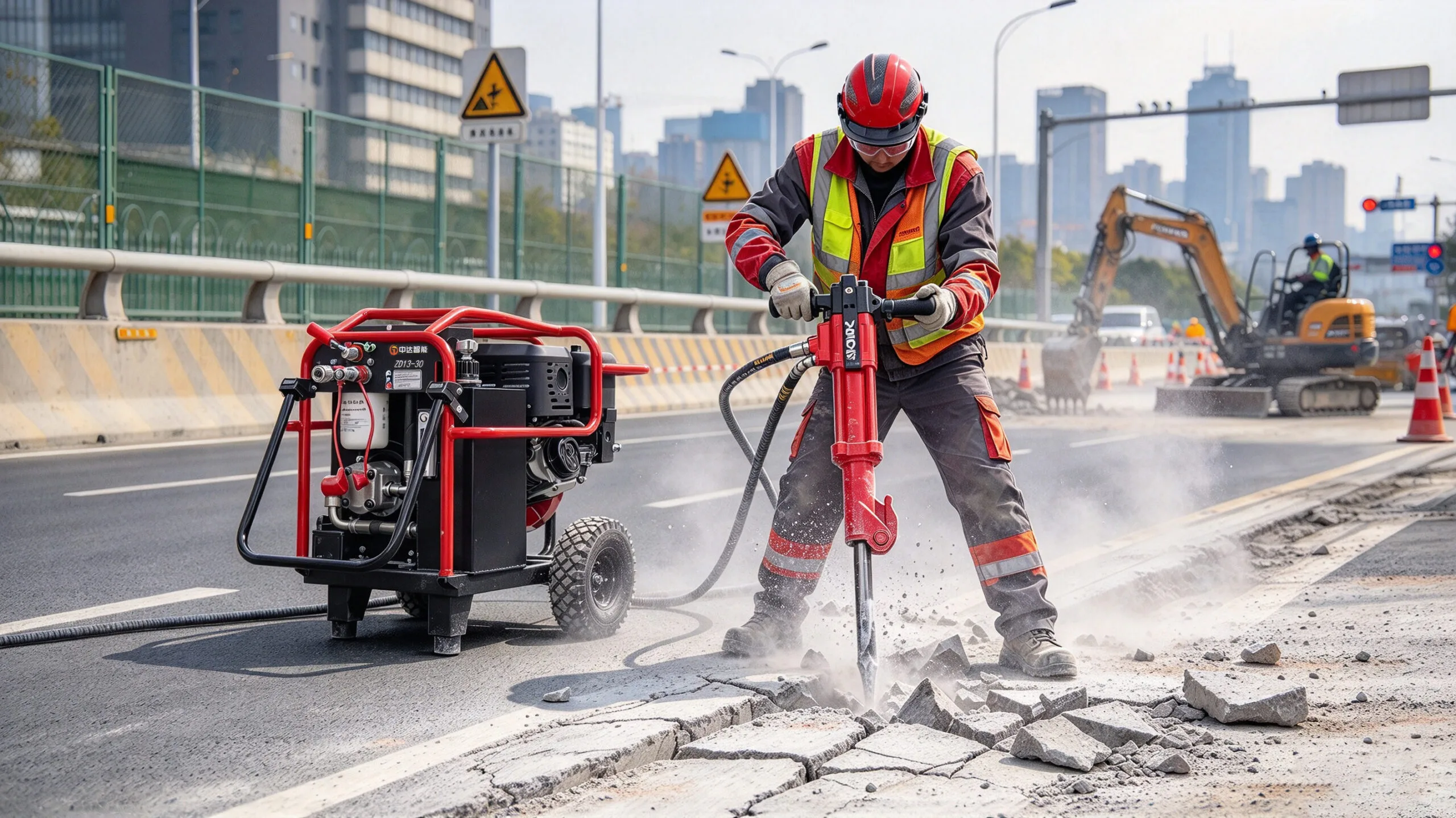
A handheld hydraulic breaker uses repeated mechanical impacts to break hard materials.
Hydraulic oil drives an internal piston, which repeatedly strikes the tool’s working end, transferring impact energy into the concrete, rock, or other material.
The operator positions the chisel against the target surface and controls the breaking process by moving the tool across the working area.
A handheld hydraulic breaker is commonly used for:
- Breaking concrete pavement and road surfaces
- Removing damaged concrete sections
- Chipping concrete around reinforcement
- Breaking rocks in construction and maintenance work
- Municipal road repair and emergency rescue operations
Compared with a hydraulic rock splitter, a breaker does not require pre-drilled splitting holes. It can begin working directly on an accessible surface, making it practical for localized demolition and secondary breaking.
However, repeated impact can generate vibration and noise. The operator also needs to control the working position and breaking sequence to avoid unnecessary damage to surrounding structures.
3. Hydraulic Rock Splitter vs. Hydraulic Breaker: Key Differences
Although both tools are used for concrete and rock demolition, their working methods and operating requirements are different.
| Comparison | Hydraulic Rock Splitter | Handheld Hydraulic Breaker |
|---|---|---|
| Working principle | Hydraulic expansion and wedge force | Repeated mechanical impact |
| Breaking method | Splits material from inside a drilled hole | Breaks material through surface impact |
| Preparation | Requires pre-drilling | Usually no pre-drilled hole required |
| Hydraulic pressure | Requires a high-pressure hydraulic supply | Uses a low-pressure hydraulic supply |
| Main advantage | Controlled splitting with reduced impact | Direct and flexible surface breaking |
| Typical applications | Large rocks, concrete blocks, foundations | Road repair, concrete removal, secondary breaking |
| Working approach | Planned splitting positions and hole arrangement | Operator-guided impact breaking |
The main difference is not simply the amount of force produced. It is how that force is transferred to the material.
A splitter is suitable when the objective is to separate a large section through controlled expansion. A breaker is more practical when the job requires direct impact on an exposed surface.
4. Which Tool Should You Choose for Different Demolition Jobs?
The best choice depends on the actual working conditions rather than the tool’s maximum force alone.
Large Rocks and Boulder Removal
For large rocks and boulders, a hydraulic rock splitter can be a suitable option when the material needs to be divided into manageable sections.
By drilling holes at selected positions, operators can guide the splitting direction and gradually separate the material.
A handheld hydraulic breaker may be more suitable when the rocks are relatively small, accessible, or need to be broken through direct impact.
Concrete Foundation Demolition
For thick concrete foundations and large concrete blocks, the two tools can serve different stages of the same project.
A hydraulic rock splitter can first create cracks and separate the main concrete sections. A handheld hydraulic breaker can then break the separated sections into smaller pieces for removal.
This combination can be useful when contractors want to reduce unnecessary impact during the initial separation process while retaining the flexibility of a breaker for secondary demolition.
Road Maintenance and Municipal Repair
For damaged road surfaces, pavement removal, and localized concrete repairs, a handheld hydraulic breaker is often more practical.
It can work directly on the exposed surface without the additional drilling preparation required by a splitter.
For larger concrete structures or thick sections that need controlled separation, a rock splitter may be considered as part of the demolition plan.

5. Can One Hydraulic Power Unit Support Both Tools?
This is an important question for contractors who need both a hydraulic rock splitter and a handheld hydraulic breaker on the same project.
The two tools have different hydraulic pressure requirements:
- A handheld hydraulic breaker is a low-pressure hydraulic tool.
- A hydraulic rock splitter requires a high-pressure hydraulic supply.
Therefore, the breaker must not be directly connected to the high-pressure supply intended for the splitter.
However, using two different types of tools does not necessarily mean that contractors need two separate hydraulic power units.
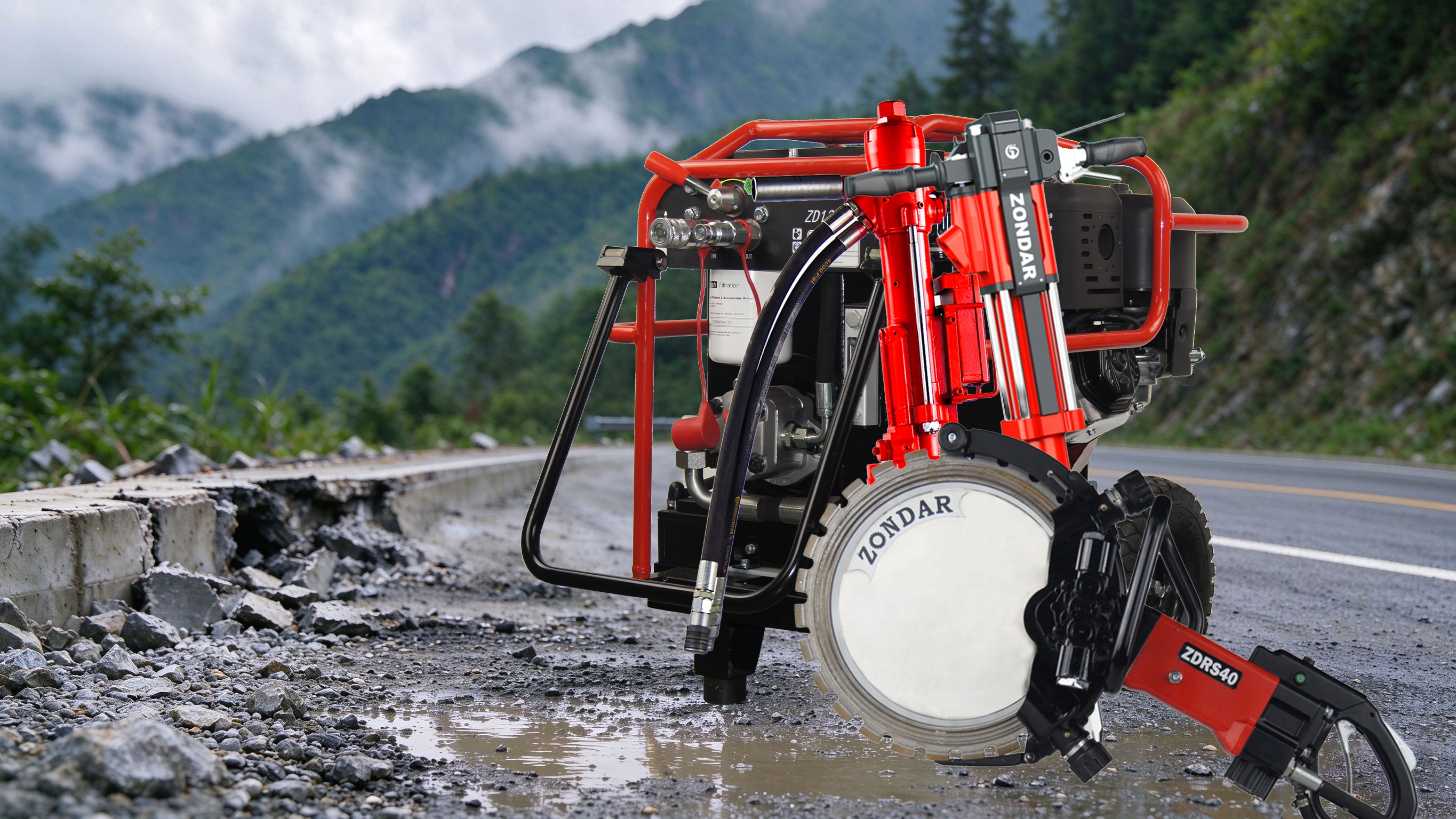
As a hydraulic equipment manufacturer with product design and R&D capabilities, ZONDAR considers different tool requirements during the hydraulic power unit design process.
Independent Hydraulic Circuits for Different Pressure Requirements
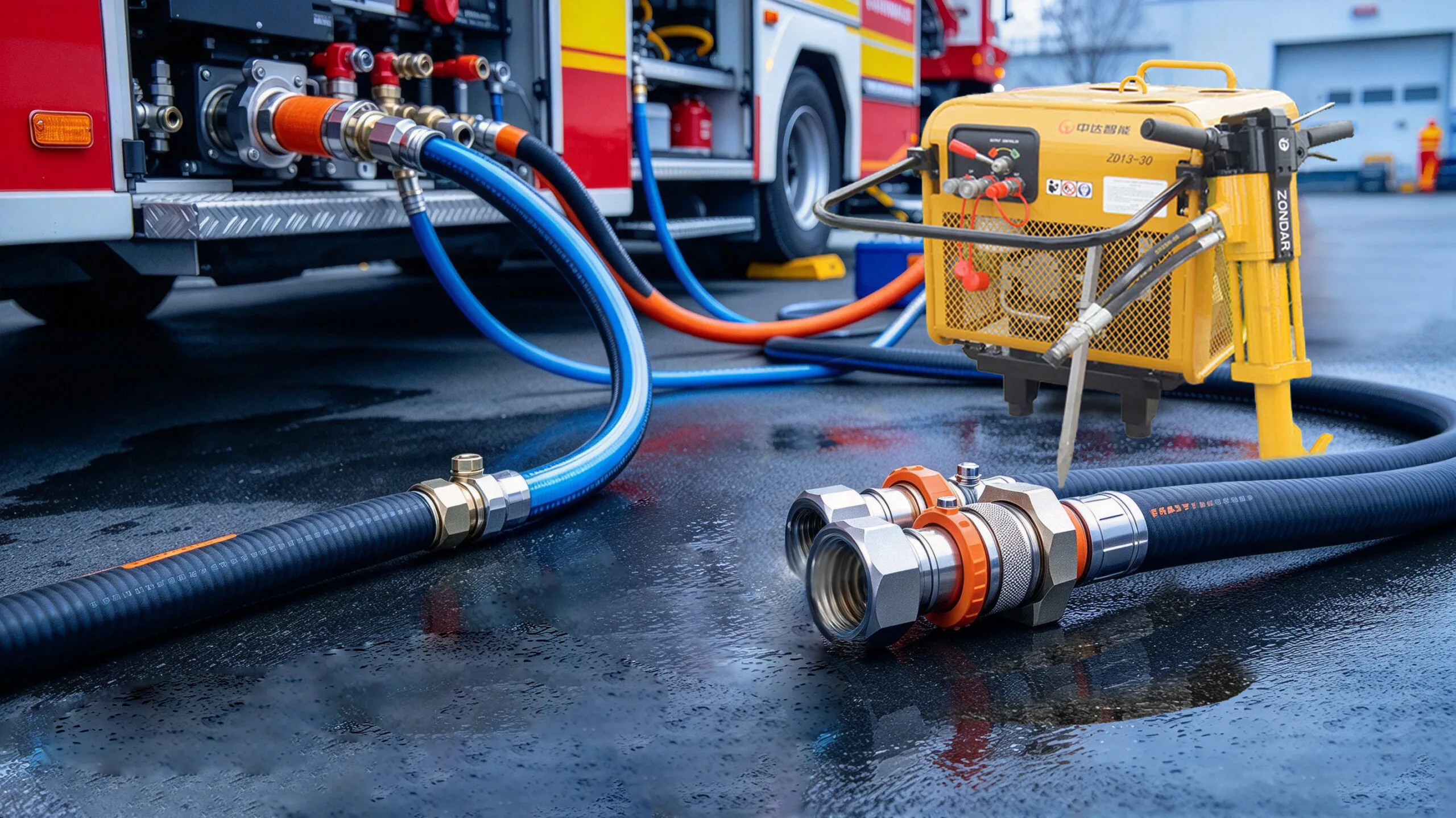
ZONDAR hydraulic power units designed for this application provide dedicated hydraulic circuits and connection interfaces for low-pressure and high-pressure tools.
The two circuits are independent. The breaker receives its specified low-pressure supply, while the splitter receives the high-pressure supply required for its operation.
Operators can switch between the two tools by selecting the corresponding hydraulic circuit. They do not need to replace the power unit simply because the project requires tools with different pressure requirements.
Pressure Booster Integration for Budget-Conscious Configurations
For projects with budget constraints, a lower-horsepower hydraulic power unit equipped with a compatible pressure booster may also be considered.
However, a pressure booster cannot be installed on any hydraulic power unit without checking its hydraulic system. The available flow, circuit configuration, pressure requirements, and connection interfaces must all be suitable.
ZONDAR incorporates provisions for compatible pressure booster integration into its multi-circuit hydraulic power unit designs. Even higher-horsepower models can retain the required circuit arrangements and interfaces for this configuration.
This means pressure booster compatibility is considered during product design rather than treated as an improvised modification after delivery.
Flow and Circuit Planning Before Production
Different pressure requirements are only one part of hydraulic tool compatibility. The available flow and circuit arrangement must also match the intended tools.
ZONDAR considers these requirements during the product design and configuration process. The hydraulic circuits and connection interfaces are planned before the equipment leaves the factory, allowing the power unit to support alternate operation of the two tools through their respective independent circuits.
It is important to distinguish this from simultaneous operation. In this configuration, the operator switches between the breaker and splitter rather than running both tools at the same time.
6. ZONDAR ZD27-60Twin: One Power Unit for Two Different Hydraulic Tools
For contractors who need both a hydraulic rock splitter and a handheld hydraulic breaker on the same project, the ZONDAR ZD27-60Twin high-pressure hydraulic power unit is one solution to consider.
Its high-pressure configuration and dedicated hydraulic circuit arrangement are designed to accommodate the different supply requirements of these two types of tools.
The operator can switch between the high-pressure splitter circuit and the low-pressure breaker circuit without changing the power unit, provided the selected configuration matches the connected tools.
For contractors working with tighter budgets, a lower-horsepower ZONDAR hydraulic power unit with a compatible pressure booster can also be considered.
The key is to select the hydraulic power system according to the actual tool combination, rather than choosing a unit based only on horsepower or maximum pressure.
7. Why Use a Hydraulic Rock Splitter and Breaker Together?
In some demolition projects, the two tools are not competing alternatives. They can complement each other.
Consider the demolition of a large reinforced concrete foundation.
The contractor may first use a hydraulic rock splitter to create cracks and separate the main concrete sections. Once the large sections have been divided, a handheld hydraulic breaker can be used for secondary breaking and the removal of remaining concrete.
If reinforcement bars remain, a suitable hydraulic rebar cutter can be used for cutting them.
This approach assigns each tool a specific task:
- Hydraulic rock splitter: Initial separation of large concrete sections.
- Handheld hydraulic breaker: Secondary breaking and size reduction.
- Hydraulic rebar cutter: Cutting exposed reinforcement where required.
The appropriate sequence depends on the structure, reinforcement arrangement, access conditions, and demolition plan. The objective is to select the right tool for each stage instead of expecting one tool to handle every task.
8. How to Select the Right Hydraulic Demolition Equipment
Before choosing a hydraulic rock splitter or handheld hydraulic breaker, contractors should consider the following factors:
- Material and structure: Is the job mainly rock splitting, thick concrete separation, or surface breaking?
- Required demolition method: Is controlled splitting more suitable, or is direct impact sufficient?
- Working environment: Are there restrictions on vibration, noise, access, or surrounding structures?
- Tool preparation: Can the site accommodate drilling before splitting?
- Hydraulic power requirements: Does the tool require a low-pressure or high-pressure hydraulic supply?
- Multi-tool requirements: Will the project need both tools, and can the selected power unit support them through properly configured independent circuits?
For contractors who regularly switch between different hydraulic tools, the power unit should be considered as part of the complete tool system.
A properly configured hydraulic power unit can simplify equipment management, reduce the need to change power sources between tasks, and provide a more practical solution for projects involving different demolition methods.
Conclusion
A hydraulic rock splitter and a handheld hydraulic breaker are designed for different demolition methods.
The splitter uses high-pressure expansion force to separate large sections of rock or concrete, while the breaker uses repeated impact to break exposed surfaces and reduce material size.
For projects that require both tools, the hydraulic power system deserves equal attention. Different pressure requirements do not necessarily mean that two separate power units are needed. With dedicated independent circuits, suitable interfaces, and proper flow planning, one appropriately configured ZONDAR hydraulic power unit can support both tools through alternate operation.
The right solution is not simply to choose a more powerful machine. It is to match the hydraulic power system to the actual tools, working conditions, and sequence of operations.